
Aluminum Crisis 2026: Why Car Prices Are About to Jump – The Perfect Storm Hitting Automakers
The automotive industry is facing its worst aluminum supply crisis in decades, and it’s about to hit your wallet. Three simultaneous shocks—a catastrophic factory fire, geopolitical supply disruptions, and punishing tariffs—have created a perfect storm that’s already forcing major automakers to shut production lines and lay off thousands of workers. If you’re thinking about buying a car in 2026, understanding what’s happening behind the scenes could save you thousands of dollars and help you time your purchase strategically. This crisis represents the most significant supply-chain disruption since the semiconductor shortage of 2021-2022, with far-reaching implications for vehicle availability, pricing, and production timelines across North America.
The Triple Threat: Three Crises Converging at Once
The aluminum shortage isn’t a single problem—it’s three compounding disasters hitting simultaneously, each blocking one of the three pathways automakers use to source aluminum. When one pathway closes, automakers pivot to alternatives. When all three close at the same time, the industry grinds to a halt.
Crisis #1: The Novelis Fire (September 2025)
In September 2025, a catastrophic fire at Novelis’s Oswego, Ohio facility destroyed approximately 40% of the United States’ domestic auto-grade aluminum supply. Novelis is the primary supplier of aluminum sheet for vehicle body panels, particularly for Ford’s F-Series trucks, which rely entirely on aluminum construction. The facility’s target restart date is the end of Q2 2026—but that assumes everything goes perfectly, which rarely happens in industrial recovery scenarios.
Ford took a $2 billion supply disruption hit in Q4 2025, with profit dropping roughly 50% to approximately $1 billion. The F-150, America’s best-selling vehicle for over four decades, has been production-constrained ever since. For a company that depends on F-Series profitability to fund EV development and other strategic initiatives, this isn’t a minor inconvenience—it’s an existential threat to quarterly earnings and long-term financial planning. The F-150 generates roughly $40 billion in annual revenue for Ford, so even a 10% production reduction translates to $4 billion in lost sales.
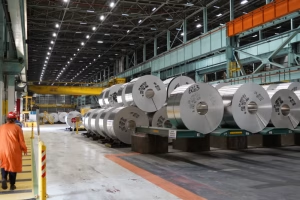
Crisis #2: Hormuz Smelter Shutdowns (March-April 2026)
Just as automakers were planning to source replacement aluminum from the Middle East, geopolitical tensions triggered force majeure declarations at two critical smelters: Alba in Bahrain and Qatalum in Qatar. These facilities were supposed to fill the gap left by Novelis. Instead, they’ve begun controlled shutdowns of their potlines—the massive electrolytic cells that produce aluminum. Restarting these potlines takes months, even after geopolitical tensions ease.
The timing couldn’t be worse. Automakers had already pivoted their supply chains to depend on Middle Eastern aluminum, signing long-term contracts and adjusting logistics. Now that source is offline, and there’s no backup plan. The ceasefire announced in early April provided temporary relief, but aluminum smelters don’t restart with a press release. Industry analysts estimate late summer 2026 before Hormuz production returns to normal levels. Alba and Qatalum together supply roughly 15-20% of global aluminum, so their shutdown has ripple effects across the entire industry, not just North America.

Crisis #3: Section 232 Tariffs (25% Duty)
The final blow is the 25% Section 232 tariff on imported aluminum. This tariff makes importing replacement aluminum from anywhere outside the U.S. punishingly expensive. When you add a 25% duty to already-elevated commodity prices, the math breaks for automakers. LME aluminum has climbed past $3,500 per tonne—approaching its 2022 peak—and the tariff makes every tonne cost 25% more. A single F-150 requires roughly 1,500 pounds of aluminum, so a 25% tariff adds approximately $400-$500 to the cost of each truck before any other supply-chain adjustments.
The exclusion window for Section 232 relief closed on April 14, 2026. The next window doesn’t open until July. For three months, automakers have no path to tariff relief, even if they can source aluminum from alternative suppliers. Ford publicly petitioned the White House for an exclusion waiver. Stellantis responded by shutting plants. Both are sending the same message: the current tariff framework is operationally unsustainable when combined with a domestic supply crisis and a geopolitical supply crisis happening simultaneously.

The Real-World Impact: Stellantis Shuts Down Production
Stellantis didn’t shut Windsor Assembly and Toluca because executives wanted a long weekend. They shut these plants because the economics of building vehicles collapsed. Windsor Assembly produces three critical vehicles: the Charger Daytona (Stellantis’s flagship EV), the Pacifica (the only viable minivan in the U.S. market), and the Voyager. These aren’t niche products—they’re core to Stellantis’s North American strategy and represent billions in annual revenue.
On Monday, April 7, 2026, 4,500 workers at Windsor were sent home. Toluca went dark through the end of April. Five supplier plants in Indiana and Michigan lost hours. The total: 5,400 people idled by a supply-chain constraint, not demand weakness. This is Stellantis’s seventh consecutive month of U.S. sales gains, brought to a halt by aluminum scarcity. The company is literally turning away customers because it cannot source materials to build vehicles.
The Toluca shutdown extending through April 30 is particularly telling. A two-week halt can be explained as a pause for clarity. A plant going dark for a month signals that management sees no near-term resolution. The company is betting that aluminum availability won’t improve enough to justify restarting production before May. This is a massive signal to the market that the crisis is expected to persist through at least mid-May, with no clear recovery timeline.
Ford’s Double Bind: No Off-Ramp in Sight
Ford’s situation is structurally worse than Stellantis’s because it has no alternative. The F-150 requires aluminum body panels that cannot be substituted with steel without a complete re-engineering program. That’s not a minor change—it’s a multi-billion-dollar investment that would take years to implement and would require retooling factories across North America. Ford invested heavily in aluminum technology specifically to reduce vehicle weight and improve fuel economy, meeting federal CAFE standards. Reverting to steel would mean abandoning that investment and facing regulatory penalties.
Ford’s options are all bad: (1) Import aluminum and pay the 25% tariff, (2) Wait for Novelis to restart and accept production constraints, or (3) Shut plants and lay off workers. The company chose option 1, publicly petitioning the White House for a Section 232 exclusion waiver. That petition sits in the quarterly exclusion window that closed Tuesday, April 14. If denied, Ford faces three more months of paying a 25% premium on a material it cannot source domestically. The financial impact is staggering: if Ford produces 500,000 F-150s annually and each truck requires $500 in additional aluminum costs due to tariffs, that’s $250 million in additional costs for a single model line.
The cumulative tariff cost to the auto industry has already passed $35.4 billion. What was once a spreadsheet exercise in margin compression is now shuttered factories and workers without paychecks. This is the real cost of tariff policy colliding with supply-chain disruption.
What This Means for Car Buyers in 2026
If you’re shopping for a vehicle in 2026, the aluminum crisis has direct implications for your wallet and timeline. Understanding these implications can help you make smarter purchasing decisions and potentially save thousands of dollars.
Prices Are Going Up
Automakers will pass aluminum costs to consumers. A 25% increase in aluminum costs translates to roughly $500-$1,500 per vehicle, depending on the model. Aluminum-intensive vehicles like the F-150, Pacifica, and Charger Daytona will see the largest increases. Expect price hikes to accelerate through Q2 and Q3 2026. Some manufacturers may absorb part of the cost to remain competitive, but most will pass the burden to buyers. If you’re shopping for a truck or aluminum-heavy SUV, expect to pay $1,000-$2,000 more than you would have in early 2026.
Inventory Will Tighten
Production constraints mean fewer vehicles on dealer lots. Popular models like the F-150, Pacifica, and Charger Daytona will be harder to find. If you’re set on a specific model, ordering now—even at higher prices—might be smarter than waiting for inventory that may not materialize until late 2026. Dealers are already reporting longer wait times for popular models, with some customers facing 8-12 week delays for F-150 orders.
Timing Matters
If you can delay your purchase until late Q2 or Q3 2026, you might catch a window where Novelis restarts and Hormuz smelters come back online. That could ease prices slightly and improve inventory. But if you need a vehicle now, expect to pay a premium and face limited selection. The sweet spot for buying might be September-October 2026, when supply constraints ease but before year-end demand surge.
EV Advantage
Interestingly, electric vehicles may have a slight advantage. EVs use less aluminum than traditional vehicles because they don’t need engine blocks or transmission housings. Models like the Charger Daytona are exceptions, but most EVs are less aluminum-intensive. If you’re considering switching to electric, 2026 might be the year to do it—aluminum constraints could make traditional vehicles disproportionately expensive. This could accelerate EV adoption faster than market trends alone would suggest.
The Recovery That Isn’t Coming Soon
Industry analysts are cautiously optimistic about late 2026, but realistic about the near term. Novelis’s Oswego facility has a target restart date at the end of Q2 2026, but that timeline assumes everything goes right—no complications, no delays, no setbacks. In industrial recovery, that’s a best-case scenario. Historical precedent suggests that major industrial facilities typically experience 20-30% delays beyond initial restart targets.
Hormuz smelters face even longer timelines. Potlines don’t restart quickly. Even if geopolitical tensions ease completely, the physical process of reheating and rebuilding those lines takes months. Industry sources estimate late summer 2026 before Hormuz production returns to meaningful levels. Some analysts are even more pessimistic, suggesting Q4 2026 before full capacity is restored.
The Section 232 tariff situation is the wildcard. If the administration grants broad exclusion waivers in the July window, automakers get relief. If not, the tariff remains a structural headwind through the rest of 2026 and potentially into 2027. Political considerations could override economic logic, leaving automakers exposed to tariff costs indefinitely.
FAQ: Your Aluminum Crisis Questions Answered
Q: Will my car be made of plastic instead of aluminum?
A: No. Automakers will absorb some costs, pass others to consumers, and potentially use more steel in some applications. But aluminum won’t disappear from vehicles—it’s too important for weight reduction and fuel economy. Federal CAFE standards require manufacturers to meet specific fuel economy targets, and aluminum is critical to achieving those targets.
Q: Should I buy now or wait?
A: If you need a vehicle now, buy. If you can wait until late Q2 or Q3 2026, you might see better availability and potentially lower prices. But don’t count on dramatic price drops—the crisis will likely persist through mid-2026. Consider your actual need versus your desire to save money.
Q: Which vehicles are most affected?
A: Aluminum-intensive models like the F-150, Pacifica, Charger Daytona, and other trucks and SUVs. Traditional sedans use less aluminum and may see smaller price increases. EVs generally use less aluminum than traditional vehicles.
Q: Will this affect used car prices?
A: Yes. Used vehicles will become more valuable as new car inventory tightens. If you’re selling a used car, 2026 is a seller’s market. Used truck prices could increase 5-10% due to new truck scarcity.
Q: Is this a temporary crisis or a long-term problem?
A: Temporary, but with long-term implications. By late 2026, supply should normalize. But the tariff situation could persist, keeping prices elevated through 2027. The structural changes to supply chains may also have lasting effects on pricing and availability.
What Automakers Are Doing Right Now
Major automakers are pursuing multiple strategies to survive the crisis: (1) Petitioning the government for tariff relief (Ford), (2) Shutting plants to reduce aluminum demand (Stellantis), (3) Accelerating EV production (which uses less aluminum), (4) Negotiating long-term supply contracts with alternative sources, and (5) Exploring aluminum recycling programs to reduce virgin aluminum demand. None of these are perfect solutions, but together they’re buying time until Novelis and Hormuz come back online.
Conclusion: Prepare for Higher Prices and Limited Selection
The aluminum crisis of 2026 is real, it’s hitting automakers hard, and it’s about to hit your wallet. If you’re shopping for a vehicle, expect higher prices, limited inventory, and longer wait times through mid-2026. If you can delay your purchase until late Q2 or Q3, you might catch a window of relief. If you need a vehicle now, buy—but understand that you’re paying a premium for aluminum scarcity. The automotive market in 2026 is fundamentally different from 2025, and buyers need to adjust their expectations accordingly.
For more insights on vehicle buying strategies and market trends, check out our First-Time Car Buyer’s Guide, Best Electric SUVs 2026, and 2026 EV Launch Radar for comprehensive guidance on navigating the 2026 automotive market.